“Staring winter with Hopeful Eyes: People in their old age begging in Devghatdham Chitwan”


Begging is one of the most native and belonging to multifaceted social problems with great magnitude, but less understood in all its dimensions. In Nepal, begging has always been an object of brief attention to charity. From time immemorial, beggars have been encouraged as noble, but with close observation and wide experience, humankind has realized that it is a vice, not a virtue for any society. On top of that, senior citizens themselves are one of the neglected, vulnerable dominated groups of society and are found below the poverty line.
Even though Nepal Laws Amendment Act, 2066 (2010) 1 2066.10.7 (21 Jan. 2010) Act Number 48 of the Year 2018 (1962) made an order to prohibit beggars to maintain good conduct and morality of the general public to make Nepal ‘beggar-free’. In practice, plans and policies are limited only in the paper. The large numbers of the elderly, the unaccompanied older adults, handicapped soldiers, the homeless and destitute, landless laborers, children, and women escaped to cities, towns, streets, and religious places for begging as a means of livelihood. Whereas it is taken as the last alternative of coping mechanisms of the aging hood, poverty, disability, and various socio-economic and political environment factors.
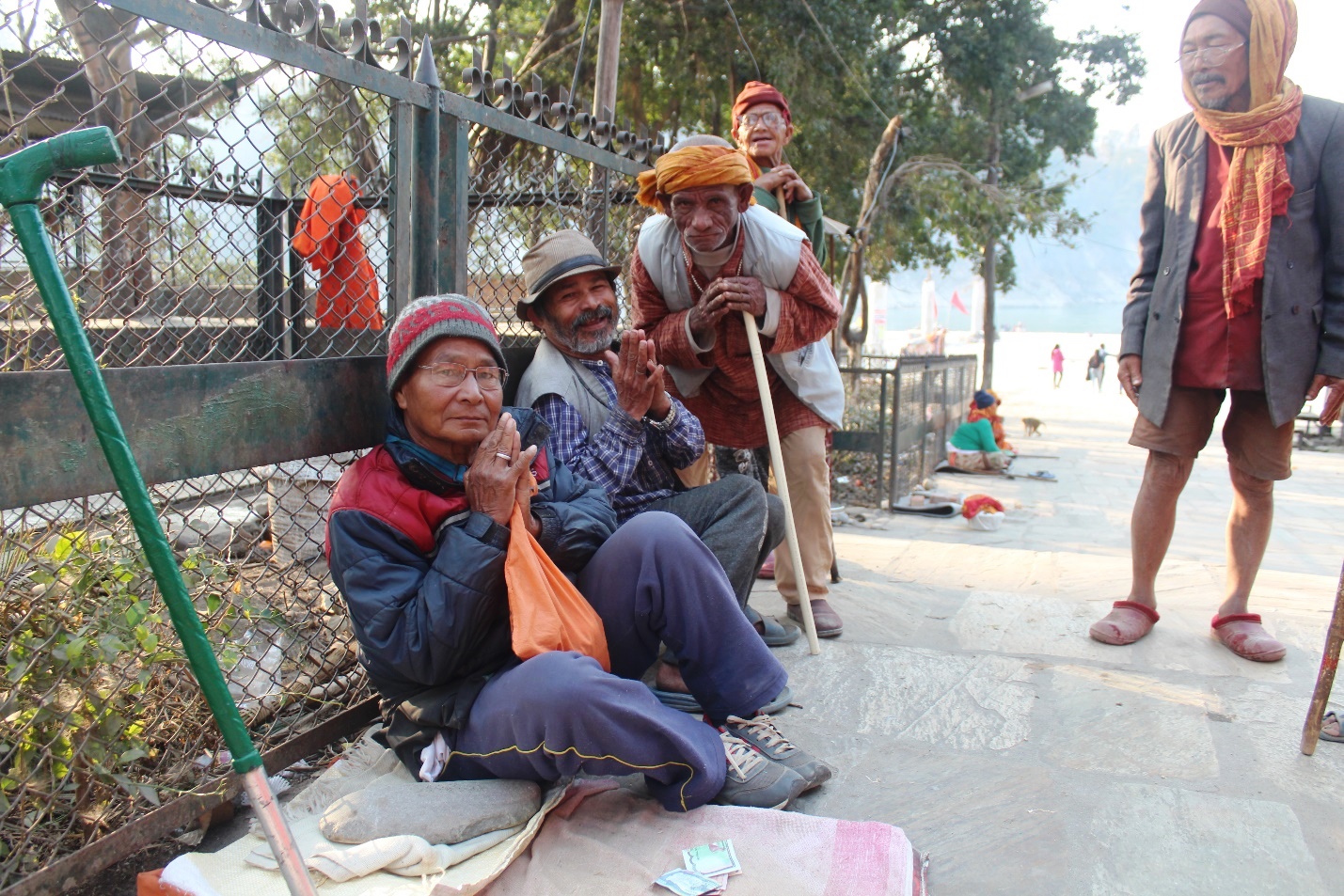
Similarly, people of Nepal are already in the new normal life after facing the COVID-19 with precautions of sanitizing, using masks, and other personal equipment. But elderly beggars in Devghat Chitwan are starting winter with their hopeful eyes of getting some favor in cash or in-kind without using any precautions, not even the mask. It is a heart-rending moment to see the people at the end of their lives stretch their hands for alms.
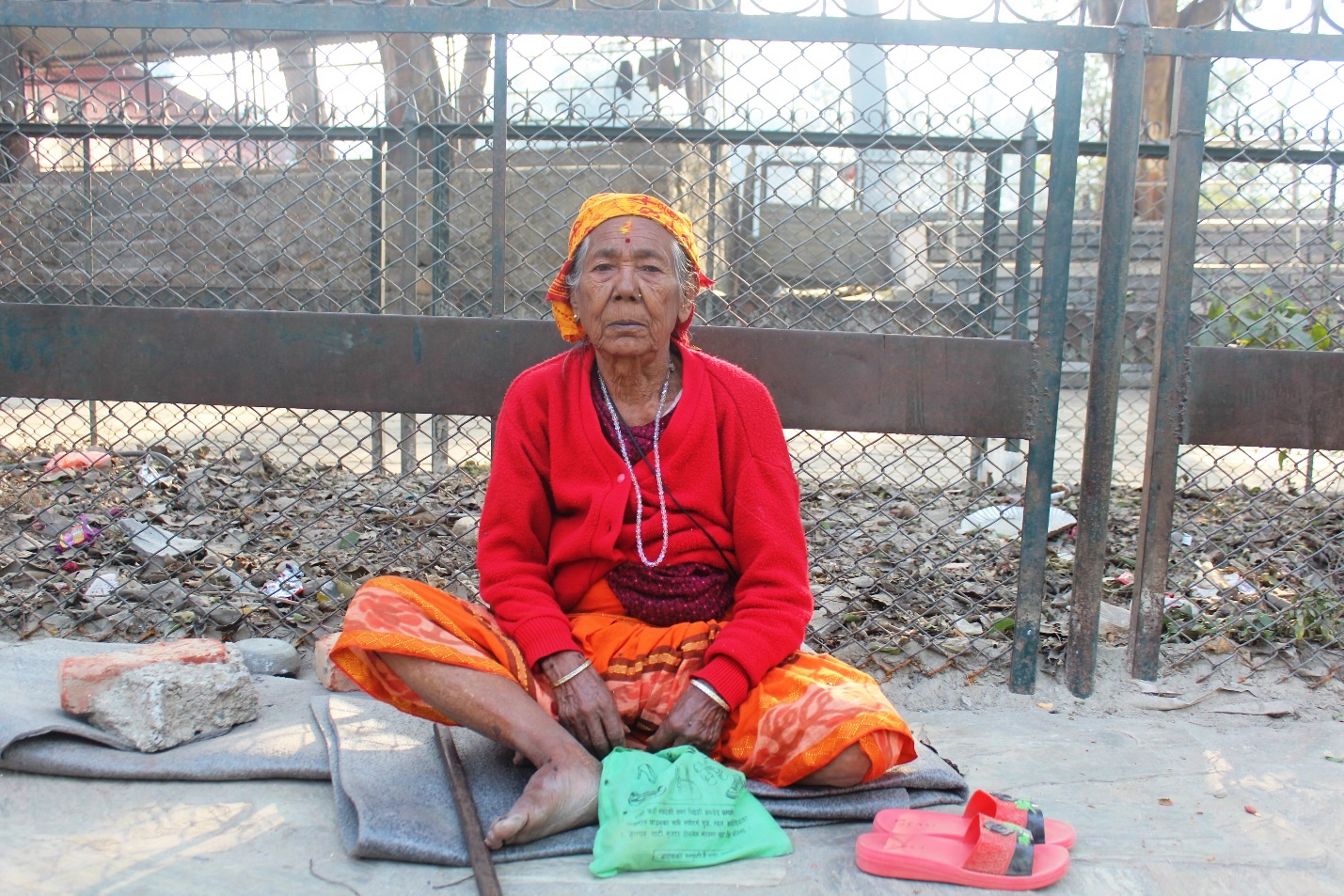
Goma Khadka has been begging in front of the Shivalaya Temple for the past 9 years. She begs from early morning 7 to 4 pm, asking for alms from the visiting devotees. On average, she earns Rs. 150 every day, she starts begging after she is abandoned by her family.
“As technically, we were not supposed to do it. But our main concern of begging is to make enough money for four square meals a day, “said the 75-year-old Lek Bahadur Magar.
“According to the local administration, we don’t fulfill the criteria of getting senior citizen allowance,” said Laxmi Shrestha who is running her 75. “Most of us doesn’t have citizenship for brida bhaata and other government health facilities,” she added.
This shows that people in their old age who survives through begging are living in stressful situations. From this point of view, people in their old age beg for various reasons. More recently, industrialization and urbanization, new forms of economic organization, social mobility, weakening of family relationships, loneliness, widowhood, mistreatment, etc. have contributed to the increase in the number of elderly restored to begging. However, rooted poverty is associated with recurrent civil war, famine, and massive population displacement, along with socio-economic crisis lead to begging.
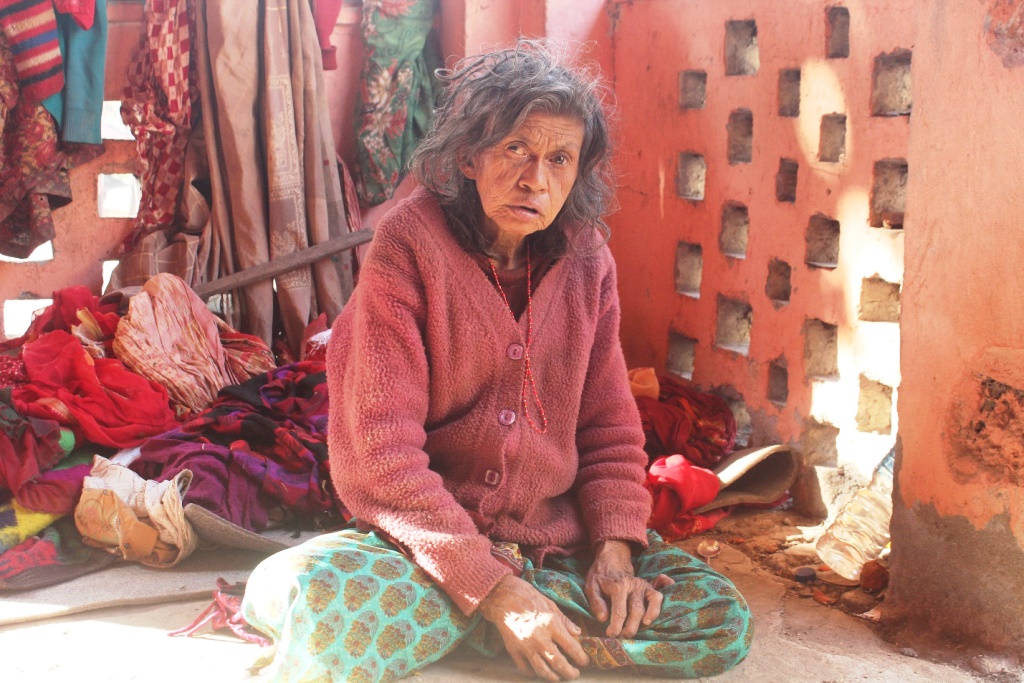
“I don’t want to beg. If I still had my good health, I would not have come here to beg. But once you are disabled, your own family ignore you and make you invisible. Why would the state look after us?” said 85-years-old Aama at Narayani River.
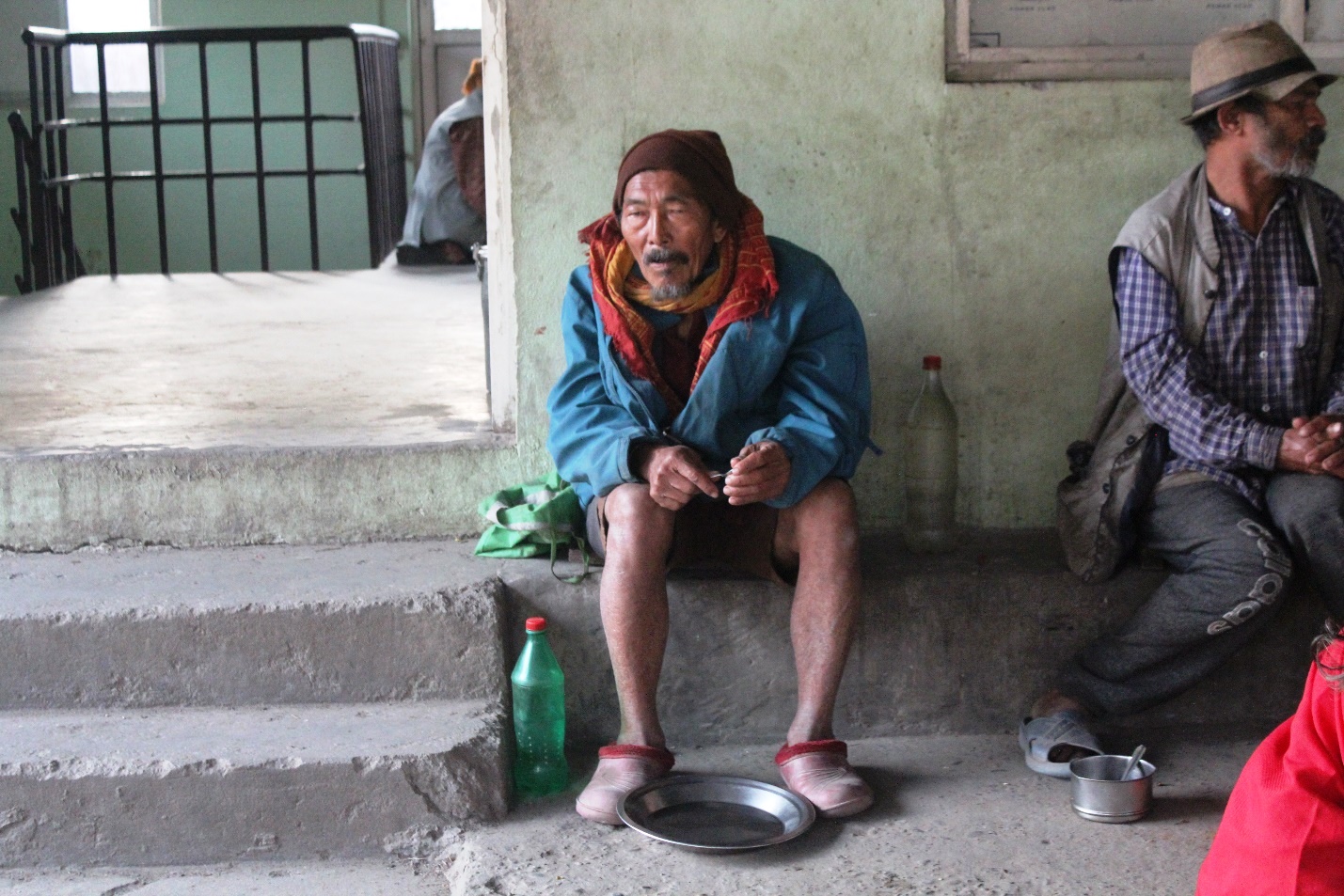
“There are several challenges that we face every day. The major problems are unemployment, lack of electricity, sanitation, potable water, proper housing (Dharmasala) various killing diseases, weather condition such as what next when it gets heavy rainfall and extreme cold seasons,” said 77 years Deepak Cheetri. “As we sleep in open place with no roof, around the graveyards,” he added.
“A kind-hearted passer-by drops a coin in my hand. I turn it over in my fingers, head bent low to hide welling tears in my eyes,” said 75-years-old Shrestha baa. “I eat, I sleep, I stay alive. That is all,” he added. He recalls the delight he once took in little things-the taste of chicken, the smell of new clothes. “I have no desires anymore,” he says.
“Most of the elderly beggars are facing multiple health problems, sight defect, difficulty walking, blindness, partial hearing impairment, joint problems, and occasional body shaking, problems of hypertension, severe headache, asthma, and depression,” said 67-year-old Lal Bahadur Thapa, a beggar from Lamjung. “While the lack of sufficient social services, family support, and proper care for the elderly are the major causes for begging. This sort of situation demoralizes us and makes us hopeless,” he added.
Strengthening and empowering the older people is an utmost need. Concerned bodies like Government of Nepal, care homes, NGOs, CBOs should establish the provision for proper rehabilitation of beggars coming from different places of Nepal. Rather than sympathetic towards the current situation of people in their old age who are begging on the street, it is better to empower and help them to uplift their livelihood through vocational training for example hand craft, tailoring, mat weaving, making flower doll, poultry.
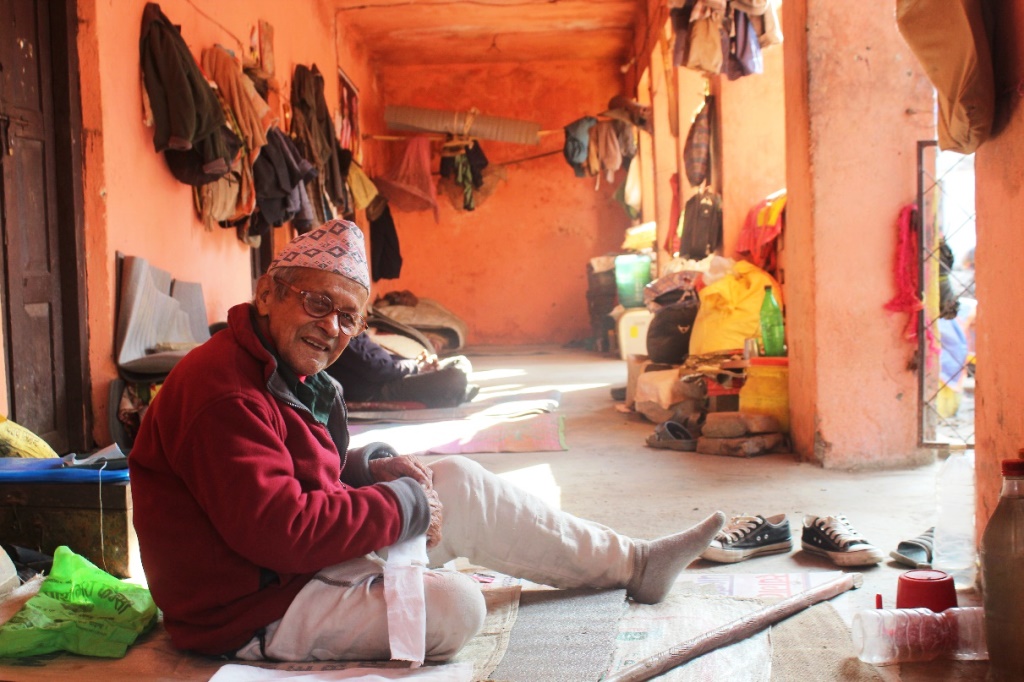
Likewise, rigorous research work is important with goal to improve the quality of life for older adults. Various researchers like social worker, gerontologist, academic researcher, civil bodies etc. should make an effort on the research quality that examines on the social, economic, physical, psychological aspect of people in their old age to elevate on the quality of life for older adults.
– Kalpana Pun is Student of Master in Social Work (Specializing in Gerontology)